


From Silence to Starry Field: How Margaret Juhae Lee Reclaimed Four Generations of Korean Family History
When Margaret Juhae Lee’s father was a little boy during Korea’s colonial era, he would sneak into his mother’s dresser and look at his father’s effects, including letters from comrades, addressed to someone named Seung-Ya, Starry Field. He didn’t know what the name meant or who it belonged to. His mother never spoke of her late husband except to say he had made her life very difficult. So, the boy grew up with his high school years interrupted by the war. He went to college, emigrated to America, became a professor, and raised a family while carrying that single poetic name, unexplained, for decades.
That name is where everything begins. Starry Field: A Memoir of Lost History is Margaret Juhae Lee’s 25-year effort to find out who was on the other side of those letters. Named a best book of the year by the San Francisco Chronicle and the Washington Independent Review of Books, praised by the New York Times Book Review and Vanity Fair, the book is part investigative journalism, part oral history, and part deeply personal reckoning with what it means to belong to a culture, a family, and ultimately oneself. To find him, Margaret had to go through the one person who had erased every trace of him.
Roots Yet To Be Found
Margaret Juhae Lee was born in the United States to Korean immigrant parents and raised in the suburbs of Houston in the 1970s and 80s. If growing up between two cultures sounds like rich ground for identity, her reality was something quieter.
“I grew up not knowing much about Korea in general and almost nothing about my ancestors,” she says. “My parents very rarely talked about the colonial era. Almost never spoke about the war. And I think that’s fairly common for Korean immigrants of that age. It was a very painful time. Being immigrants, they were just looking ahead.”
Her parents made an early decision to speak English at home. Margaret could pick up the gist of her parents’ conversations in Korean, but couldn’t read it. They ate Korean food every night. Her uncle sent beautiful calendars from Korea each year. Her mother wore a hanbok on major occasions, but Lunar New Year wasn’t celebrated. There was no Korean neighborhood, no concentrated community, just two other Korean families they knew in all of Northwest Houston.
“I was exposed but not immersed,” she says simply.
That changed when she moved to the Bay Area in 1992. “I realized that there’s a significant Asian American history. That whole world opened up to me when I was in my 20s.”
The Stars Were Always Out
While Margaret was building her sense of identity in California, her father was doing something of his own reckoning. In the early 1990s, he returned to Korea on sabbatical and began researching his father. Margaret’s grandfather, Lee Chul Ha, had been part of an organized student independence movement, one of many groups fighting against Japanese colonial rule of Korea in the late 1920s. He was in newspaper archives. He had been a leader, affiliated with prominent figures in the independence movement, and had been imprisoned by the Japanese for his involvement. To his own family, he had long been considered a source of shame, a dangerous figure to acknowledge, particularly during and after the Korean War, when such associations could put lives at risk. His wife, Margaret’s grandmother, had spoken of him only as a burden. But the Patriot’s Medal changed all of that: South Korea officially recognized Lee Chul Ha as a Patriot, and his grave was relocated to the National Cemetery, transformed, in the official record, from criminal to hero.
In 1995, while working as a curatorial assistant at SFMOMA, Margaret flew to Korea for her grandfather’s reburial ceremony. As part of the official Patriot recognition, his remains were relocated to the National Cemetery, a formal act of national honor for a man his own family had been taught to forget. A year later, she left the Bay Area to attend graduate school in journalism at NYU. She later worked as a literary editor at The Nation. “I realized then that this was the story of a lifetime. Who was this man who is now a hero that nobody ever talked about?”

Q: How did discovering your grandfather’s story impact your father’s life?
Margaret: It really changed him. Before then he was a very quiet person. He had been carrying around so much shame his whole life because his father was portrayed by his mother as a source of pain. And then to discover that he was a leader in the movement and an intellectual, I think was a revelation. It was like the weight was lifted. He became much more effusive. His personality really changed.
Q: The book’s title, Starry Field, comes from your grandfather’s pen name. Can you tell us about that?
Margaret: Starry Field is a translation of my grandfather’s pen name, Seung-Ya, which my father remembered seeing on letters from his comrades. When my father was little, he would sneak into my grandmother’s room and look at my grandfather’s effects. He saw “dear Seung-Ya” and thought it was such a beautifully poetic name. It evokes idealism and looking beyond. When I heard that name, I knew it had to be the title of the book. It has been from the very beginning.
Q: What did you discover about who Lee Chul Ha actually was as a person?
Margaret: He had wide-ranging intellectual interests, he was engaging deeply with the ideas of his time. But one of the things that really struck me was that as a high school student, on the Japanese emperor’s birthday, he and a group of students wore Korean funerary robes in protest. Just the audacity to do that at that age, in such a visual manner… He believed in something so much that he was beaten, he was kicked out of school.
Q: The book is framed as your grandfather’s story but quickly shifted into something else.
Margaret: I feel like this book, which began as a book about my grandfather, became a book about my grandmother. She was not a political person. She was just living her life, starting as a very sequestered girl who gets married with no say in any of her decisions. And yet she had to navigate everything. My grandfather is now lauded as a hero, but at the same time, he made the lives of his family very difficult. I wanted both of those stories in there, to see the complexity. Her decisions weren’t selfish. She was protecting her children. Everything she did was because she was a mother.
Margaret’s grandmother was born in 1908. She was married at 16 to a man she’d never met. Her mother had died when she was eight. She survived colonialism, the death of her husband in his late 20s, widowhood with two small children, war, dictatorships, and reconstruction. She lived nearly the entire 20th century, dying at the age of 90 in 2000. During the Korean War, fearing what her husband’s records could mean for her sons, she burned everything; his letters, his books, his effects. Every trace.

Q: How did you get her to agree to share her story?
Margaret: At first, I was appealing to her emotions. And then I realized that was not the right tactic for her. She was a tough grandma! So, I had to be pragmatic and tell her that this is for my job. Only then did she agree.
Once she started opening up, she barely needed prompting. The interviews became monologues. Margaret’s mother helped translate (her grandmother refused to have Margaret’s father in the room) and what came out was extraordinary. She described the moment she saw her husband after his release from prison, noting his pulled-out fingernails, in a complete monotone. She recounted the first time she ever attended school, night school in Seoul, the one period she was permitted to visit her husband in prison. “That’s the first time she experienced freedom,” Margaret says quietly.
The structure Margaret eventually chose, organizing the entire book around those three long-form interviews, was a way of honoring that truth. Her grandmother isn’t a supporting character. She is, as Margaret says, the book’s true heart.
Q: Since you’ve published the book, has your research kept revealing new things?
Margaret: Last year a second cousin contacted me to let me know that my grandmother’s sister was also involved in the independence movement. She was in prison too, as a teenager, but only for a week. She died in the late 1940s and never told anyone. The South Korean government contacted my second cousin’s family to tell them that they wanted to honor her as a Patriot. It’s incredible.
The book hasn’t finished revealing itself. Later this summer, Starry Field will be published in a Korean translation just in time to commemorate Liberation Day, August 15..
“It’s one of my dreams for this book,” she says. “I get to share that with my family.”
Finding Home Through History
There is a passage near the end of Starry Field written as a fairy tale; a third-person story about a girl born in a country where she didn’t feel at home, who traveled to her parents’ homeland and didn’t feel at home there either, who kept searching until she found something she hadn’t known she was looking for. “The woman still didn’t feel at home in either of the two countries, but she did feel at home with her family.”
That image of home, not as a place but as a relationship with the past and the people you share it with, is what the entire book builds toward.
“I moved around a lot as a young adult,” Margaret says. “I lived on the West Coast, the East Coast. I grew up in Texas. I lived in Minnesota. And I never felt at home anywhere. I needed to do this research to find home.”
It wasn’t until she had children that she understood the book’s deepest purpose. “I realized that I wanted to present this story to my children, so they would grow up with family stories that I did not have the privilege of knowing..”
She takes her children to Korea. They visit the National Cemetery where Lee Chul Ha and her grandmother are buried. They have been to Seodaemun Prison, now a museum, where he was held. “It’s very heavy, but they understand—my great-grandfather was here.”
Q: How has the Bay Area shaped your sense of community since the book came out?
Margaret: I’ve found community in different places. There’s a group I helped found called Radical Ahjumma. We’re all middle-aged female writers from the Korean diaspora. We want to celebrate that word ahjumma, which has some derogatory connotations. At the AWP writing conference every year, there’s also a group called the Fourth Kingdom made up of all Korean American writers. That’s been maybe one of the best things about publishing a book: discovering this community that I knew existed but had never felt truly part of.
There is also something new taking shape in her writing life. Her mother, who had dementia in her final years, reverted entirely to Korean. She wrote in Korean. She spoke only Korean. She lived in her memories of Korea, recalling walks in Seoul parks with her sisters, not knowing she had slipped into another language. “The deepest part of her was in Korea,” Margaret says. “And I’m writing about that now.”
Starry Field: A Memoir of Lost History is available now wherever books are sold. The Korean edition will be published by Hankyoreh in late July 2026. Learn more about Margaret Juhae Lee’s work at margaretjuhaelee.com and on Instagram.

This book, which began as a book about my grandfather, became a book about my grandmother.
When asked for a Korean cultural work that resonates with her, Margaret reached for a book on her shelf.
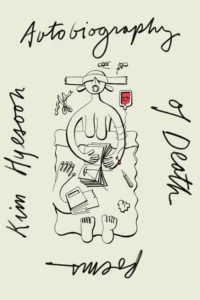
“Kim Hyesoon’s Autobiography of Death. I took a class with a Korean American poet named Janice Lee on Korean literature and death rituals—a a very, very heavy topic. But it was just eye-opening.”
She also spoke of her current interest: Dictée by Theresa Hak Kyung Cha, a notoriously complex, multilingual work published just before Cha was murdered in 1982. Margaret’s Radical Ahjumma group has formed what they call a Dictée Support Group to work through it together.
“It goes into history, Korean history, her mother’s history, her existence between languages; French and Korean and English. It’s so rich. And it’s been very much on my mind as I explore my own mother’s story.”

Featured image: Courtesy of Margaret Juhae Lee